
 RAAHAT ▪ 2026
Delhi's winter isn't a season for everyone. For families with a roof and a heater it's a few weeks of fog. For people sleeping on pavements, in half-built shelter, along the brick stacks, it's the most dangerous stretch of the year.
Between 15 December 2024 and 10 January 2025 (56 nights), 474 homeless people died in Delhi for want of warm clothing, blankets and shelter. The count came from the Centre for Holistic Development, and the National Human Rights Commission took formal cognisance of it (NHRC, winter 2024–25).
homeless deaths in Delhi across 56 winter nights
Source · NHRC (citing Centre for Holistic Development), winter 2024–25
A single bad winter isn't a fluke. Across India an average of about 810 people a year died of cold exposure over 2013–2022, and 3,639 people died in cold waves between 2019 and 2023 (NCRB, Accidental Deaths and Suicides in India). Cold is a recurring, documented killer, not a freak event.
The people it kills are the hardest to count while they're alive. According to the Centre for Holistic Development, about 80% of the unidentified bodies recovered in Delhi are believed to be homeless, a measure of how invisible this group is (cited in the NHRC release, 2025).
average cold-exposure deaths across India, 2013–2022
Source · NCRB, Accidental Deaths and Suicides in India
The 2011 Census counted 1.77 million homeless people in India, 46,724 of them in Delhi. Civil-society head-counts since put the real Delhi figure many times higher: one 2024 street count extrapolated to over 300,000 (Census of India 2011; Shahri Adhikar Manch, 2024). The official number is a floor, not a ceiling.
Many aren't 'homeless' in the way the word sounds. They're seasonal migrants (the people who fire the bricks, lay the roads, dig the foundations), living where the work is, in the open or under tarpaulin. Around 90% of India's workers are informal, with no contract and no paid leave to fall back on (WIEGO, drawing on NSS/PLFS). A cold snap and a lost week hit the same household at once.
On the coldest Delhi nights the temperature sits around 2–4°C, and through January 2024 it stayed consistently below 4°C (IMD readings, as reported in the 2024 cold-wave coverage). At those temperatures a blanket, a warm layer and dry footwear are not comfort items. They're the difference between exposure and getting through the night.
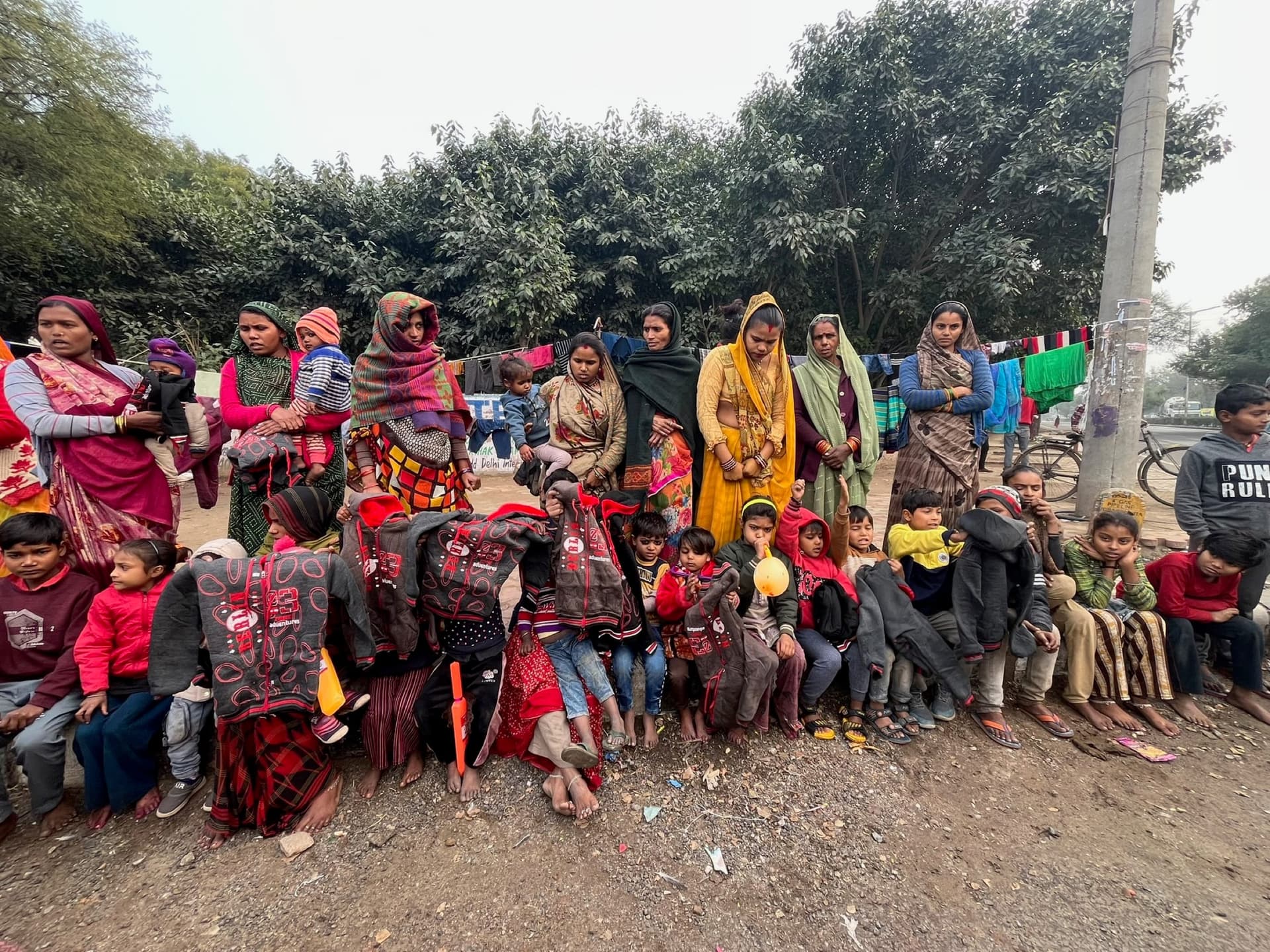
Project Raahat distributes blankets, warm jackets and winter essentials to homeless individuals, migrant workers and vulnerable families through the Delhi winter: 10,000+ winter items to date, to 8,500+ families (Pledge A Smile Foundation records, confirmed September 2026). A kit doesn't solve homelessness. It removes the specific risk that turns a cold night into a fatal one.
We go out to the settlements rather than wait for anyone to come to a centre, because the people most exposed to the cold are the ones least likely to be on any list.
The numbers are real.
So is the need.