 MUSKAAN ▪ 2026
India's dropout rate isn't spread evenly. It's low at primary (1.5%) and upper-primary (3.0%), then jumps to 12.6% at the secondary level: Classes 9 and 10, right before the board year (Ministry of Education, UDISE+ 2021–22). That's the cliff. But the small costs that push a family toward it start years earlier.
dropout rate at the secondary level (Classes 9–10), the peak
Source · Ministry of Education, UDISE+ 2021–22
A government school charges no fees. Families still spent about ₹8,331 a year per child to keep one in it, rising to about ₹9,013 at the secondary level (NSS 75th Round, 2017–18). Of that, roughly 20% goes to books, stationery and uniforms and about 12% to transport: the fees the classroom doesn't charge but the year still does.
When enrolled children stop attending, money is a leading reason: financial constraints were cited for 24.3% of boys and 17.7% of girls, and needing to earn for 36.9% of boys (NSS 75th Round, 2017–18). The barrier is the cost of turning up, more often than the distance to school or its quality.
what a family spends per child on a 'free' government education
Source · NSS 75th Round, 2017–18
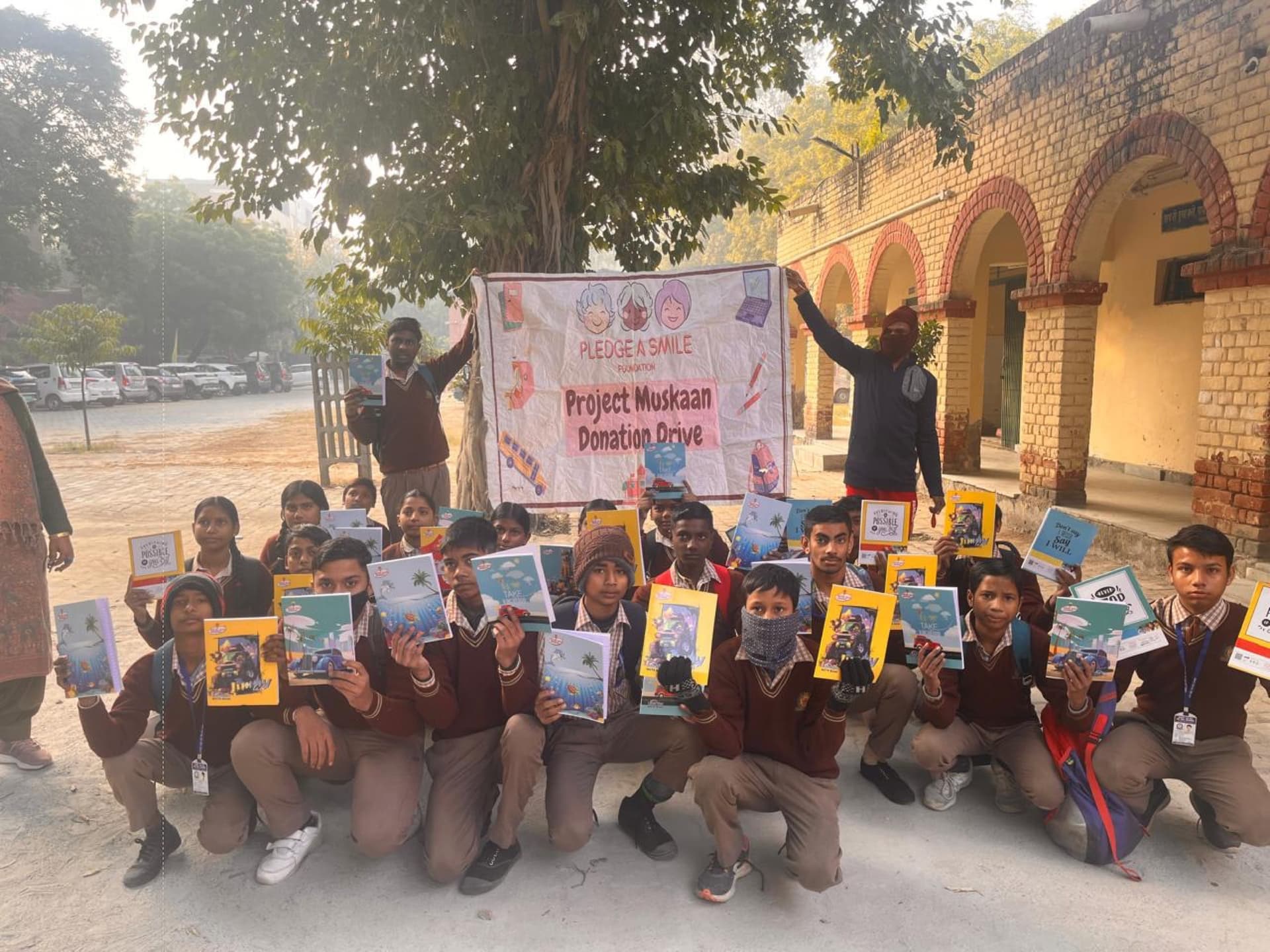
Project Muskaan runs on a documented per-child cost of about ₹12,000 a year, roughly ₹3,68,000 per centre, across 30–35 children each (Pledge A Smile Foundation records, confirmed September 2026). It isn't an estimate; it's the org's own reported figure.
That money buys the things the classroom doesn't: books and activity materials, uniforms, shoes and bags, notebooks and stationery, snacks, and the classroom repairs that make a bridge class usable. The spend maps almost exactly onto the 20% of household education cost the NSS says trips families up.
documented cost of a year of Project Muskaan for one child
Source · Pledge A Smile Foundation records, confirmed September 2026
A dropout is expensive long after the school year ends. The World Bank puts the lifetime earning loss of one child who leaves school early at about $5,700 (World Bank). Against that, a year of school for the price of a phone is not charity. It's the cheapest intervention on the table.
The context is the scale: 3.22 crore children aged 6–13 are out of school in India, and about 80% of them come from migrant and daily-wage families (UDISE+ 2021–22; UNICEF India / RTE Forum). Reaching them early, before the Class 9 cliff, is the whole design.
estimated lifetime earning loss per child who drops out early
Source · World Bank
The numbers are real.
So is the need.